What's So Special About Osaka Castle?
The concrete differentiators that set Osaka Castle apart: the buried Toyotomi stone walls, the castle with the greatest stone walls in Japan, the 1931 citizen-funded tower, and a record 2.8 million annual visitors.
What's So Special About Osaka Castle?
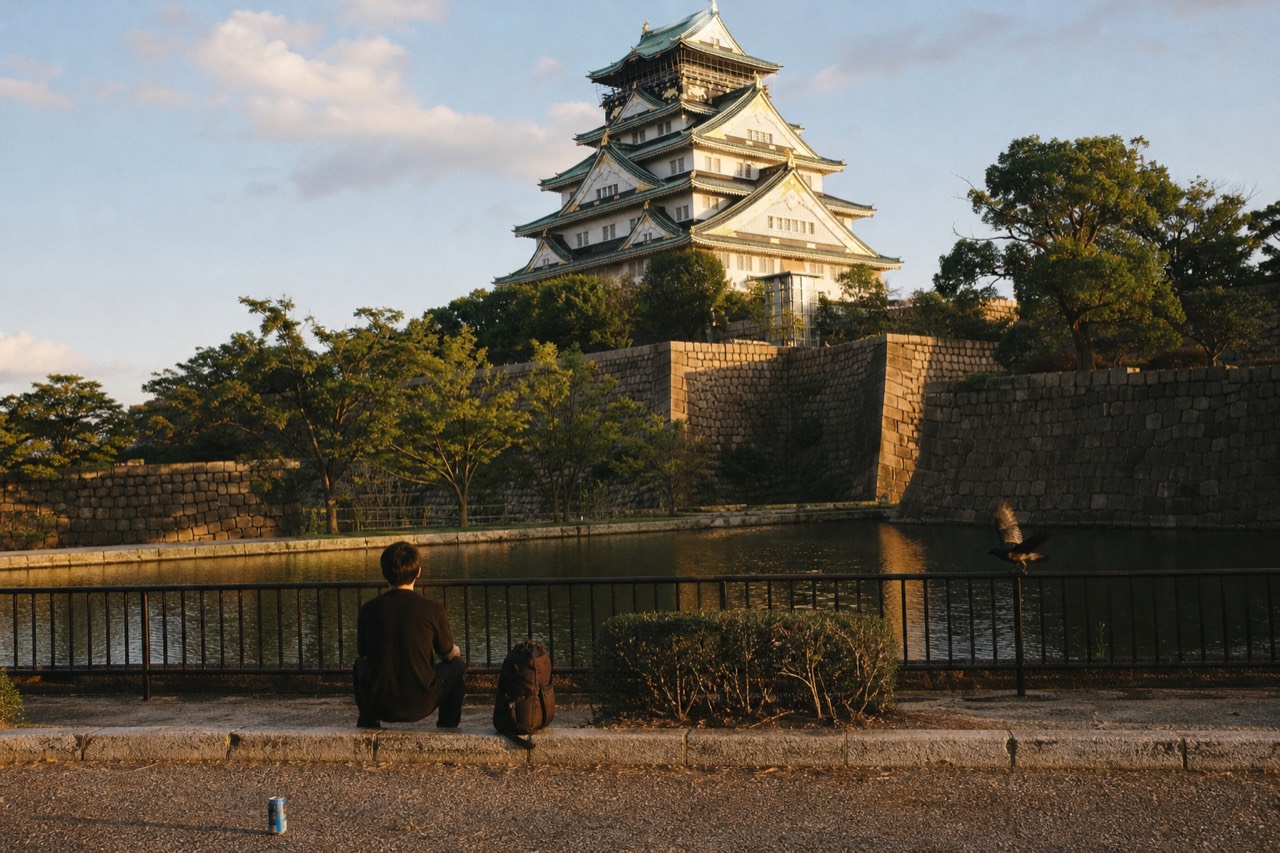
Osaka Castle's single unmatched feature is the wall itself: when the Tokugawa shogunate rebuilt the castle from 1620, it buried Hideyoshi's original stone walls under metres of fill rather than reuse them, and since 1 April 2025 you can walk down inside the honmaru and look at a section of that buried Toyotomi wall, the only place where the buried Toyotomi wall is on display. The ¥1,200 tower ticket includes it.
That is the headline differentiator, and it is genuinely unique. Himeji, Matsumoto, Kumamoto and the other famous keeps survive as architecture. Osaka Castle survives as an archaeological sandwich: a Tokugawa-era stone fortress with an entire hidden Toyotomi castle sealed inside its foundations, rediscovered by accident in 1959 and opened to the public as the Osaka Castle Toyotomi Stone Wall Museum on 1 April 2025. The official English leaflet puts the burial depth plainly: about six metres of earth piled at the nakanodan tier, completely burying the Toyotomi-period stone walls.
Around that core, the castle piles up more superlatives than first-time visitors expect. The castle's own press materials call it the castle with the greatest stone walls in Japan, a claim it makes on the strength of the massive granite ramparts ringing multiple moat systems. The 8F observation deck sits about 50 metres above ground, per the official exhibition page. And in fiscal year 2025 the Main Tower admitted 2,813,851 visitors, a provisional all-time record and the first time since the tower opened in 1931 that it has passed 2.8 million in a year. This page on Osaka Castle Tickets exists because that many people keep asking the same practical questions.
There is a third layer to the answer, and it is the one locals tend to care about most. The tower you photograph is not a survivor. It is a 1931 ferro-concrete reconstruction, built after the previous Tokugawa keep burned in 1665, paid for not by a daimyo or the state but by public subscription from the citizens of Osaka on the proposal of mayor Seki Hajime. It has been a museum since the day it opened. That history matters if you want to understand what you are actually looking at when you go inside: a 1931 museum inside a 1620s fortress footprint inside a 1583 Toyotomi foundation, with the oldest layer visible again only since 2025.
If you want to see the special part, the buried wall, admission is the route in.
What Makes The Stone Walls Different From Every Other Castle?
The stone walls are the claim to fame no other Japanese castle can contest, because the Tokugawa rebuild used fill on a scale nobody else attempted: over the inner moat a 1969 boring struck buried stone about 25 metres below the surface, meaning the shogunate raised the entire castle platform by more than 25 metres in places. The surviving Tokugawa walls top out at elevations the Toyotomi castle never reached.
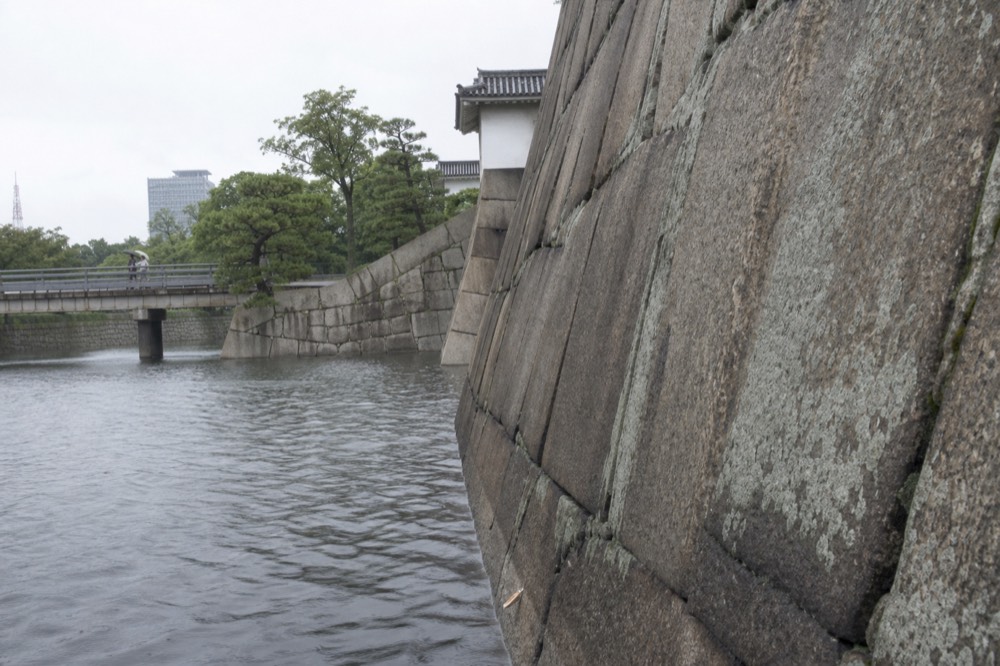
Start with the phrase the castle itself uses. Its 2024 press release for the stone-wall map calls Osaka Castle "the castle with the greatest stone walls in Japan", and the English Stone Wall Museum leaflet repeats it. The basis is visible from any gate: huge granite blocks fitted in nozurazumi natural-face masonry, ramparts rising straight out of the water, and giant stones at the Sakuramon, Otemon and Kyobashi-guchi masugata gate squares that the official park map labels as named features in their own right. The map deliberately prints no dimensions for those stones, and neither will we, because no official page states any figure.
Then there is the engineering. When the Tokugawa shogunate began the rebuild in Genna 6 (1620), it did not repair Hideyoshi's castle. It entombed it, piling fill across the whole site "as if to erase the authority of the Toyotomi family", deepening the moats and raising a new castle 15 metres taller than the Toyotomi keep had been. A 1969 soil boring drilled in the honmaru before the EXPO'70 Time Capsule was buried struck stone about 25 metres down, which is the depth of fill on the moat line. Inside the honmaru itself the burial was about 6 metres, and the ground Hideyoshi and Hideyori walked on now lies roughly one metre below today's surface.
The 13 Important Cultural Property structures designated in 1953 give the walls their texture: Otemon, three stretches of wall, the Tamon-yagura, Sengan-yagura, Inui-yagura, Ichiban-yagura, Rokuban-yagura, the Ensho-gura powder magazine, the Kinzo, the Kinmeisui well house and the Sakuramon. Two of the turrets, Sengan-yagura and Inui-yagura, both built in 1620 under Kobori Enshu, are the oldest surviving buildings at the castle and stand inside Nishinomaru Garden. The museum's own curatorial column on heights adds a comparison most guides skip: the Tokugawa keep was about 58 metres tall, roughly 3 metres taller than today's reconstructed tower, and Hideyoshi's tower, at about 40 metres on its three-tier base, sat about 16 metres lower than the one you see now.
| Layer | Built | Height or depth | Visible today |
|---|---|---|---|
| Toyotomi tenshu | 1583 | about 40 m above the tsumenomaru surface | Buried under about 6 m of fill; the tsumenomaru wall is viewable in the Stone Wall Museum |
| Tokugawa tenshu | 1620s | about 58 m tall | Burned 1665, never rebuilt |
| 1931 reconstructed tower | 1931 | 8F observation deck about 50 m above ground | Standing; Osaka City Designated Tangible Cultural Property since 2025 |
The one place you can see the older layer is the underground gallery, and the official detail worth repeating is what the exposed wall protected: the tsumenomaru, the private quarters where Hideyoshi and his wife One, and later Yodo-dono and Hideyori, lived. You are looking at the wall around the family's bedroom. That specificity is the difference between Osaka Castle and every keep that merely survived.
The Osaka Castle Museum and Tower Entry Ticket is the standard way in: it covers the Main Tower and the Stone Wall Museum with a QR entry, no fixed time slot, and a 30-day validity window. See our inside Osaka Castle floor guide for what each floor holds.
The difference between the ticket and a guided walk is worth stating plainly, because they answer different questions. The ticket is self-guided admission, no guide and no headphones, covering the two venues. The guided walking tour is a live English-speaking guide for the castle grounds, 1.5 to 3 hours, and its base price does not include tower admission, which is handled separately if you choose that option. They stack, they do not substitute. Our Osaka Castle guided tours comparison breaks down who each one suits.
How Does A 1931 Reconstruction End Up Feeling Special?
The tower is the third keep on the site and it exists because citizens paid for it: rebuilt in Showa 6 (1931) by public subscription after the Tokugawa keep burned in a 1665 lightning strike, it was designed as a museum from day one and was built so as not to load the original Toyotomi tenshudai mound beneath it. That decision saved it in 1945, when a bomb a few metres away deformed the base but left the tower standing.
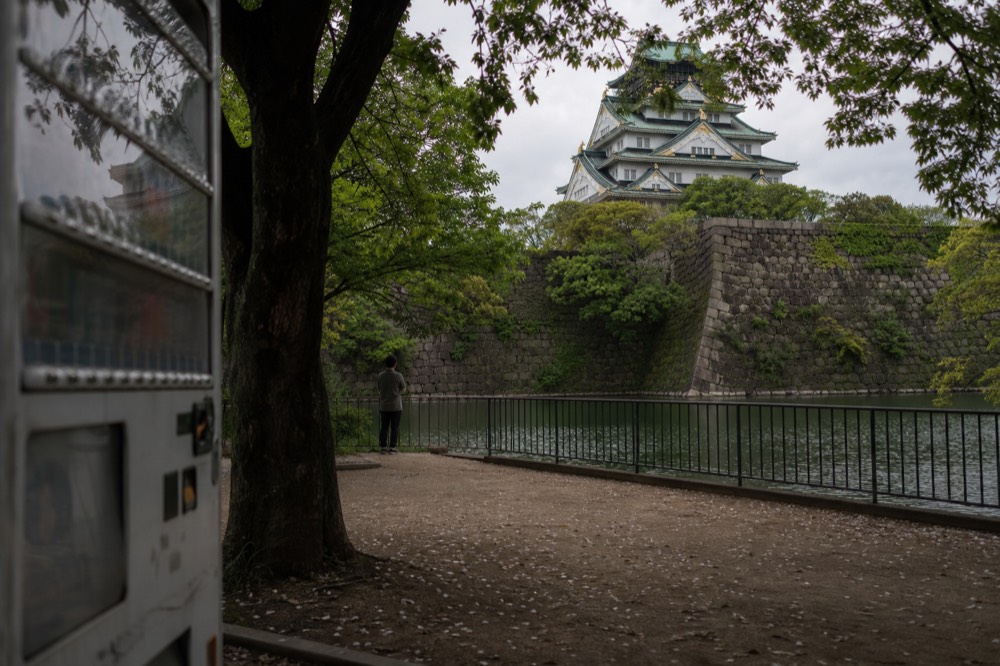
This is the part of the story that trips up visitors who arrive expecting Himeji. The Tokugawa tenshu burned in Kanbun 5 (1665) and was never rebuilt, so the site stood keepless for more than two and a half centuries. In 1931, on the proposal of mayor Seki Hajime, the citizens of Osaka funded a new tower by public subscription. It is five exterior tiers and eight interior floors, a ferro-concrete structure dressed as a castle, and it became a National Registered Tangible Cultural Property in 1997 and an Osaka City Designated Tangible Cultural Property in Reiwa 7 (2025).
from $7.69 The from-price you see online and the price at the castle window are the same adult admission, so booking ahead costs nothing extra.
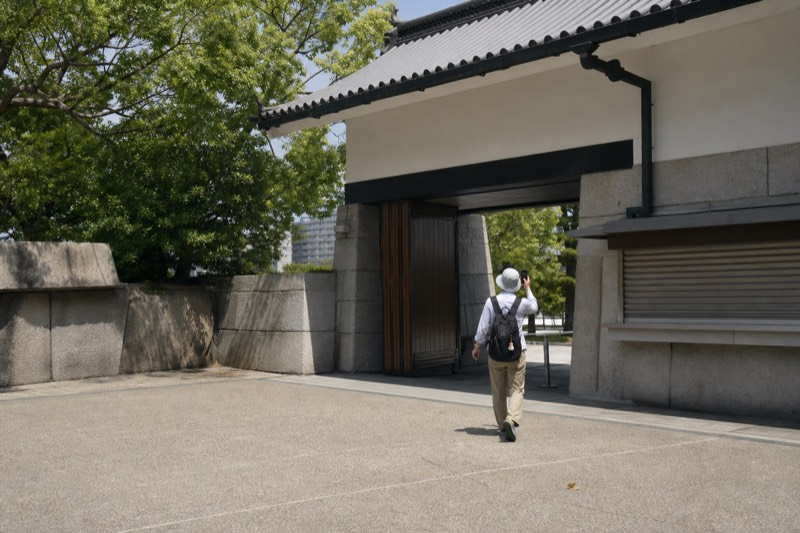
Your ticket into the tower
Official E-Ticket
- Osaka Castle Main Tower entry
- Osaka Castle Toyotomi Stone Wall Museum
- QR code entry
- Valid 30 days
- No fixed time slot
- No viewing time limit
Buying the official e-ticket ahead saves you the ticket-purchase line, not money, since the online price matches the window. You exchange nothing at the gate, you simply show the voucher and go in.
The real flexibility here is the voucher's 30-day validity, with no fixed time slot and no set viewing time limit.
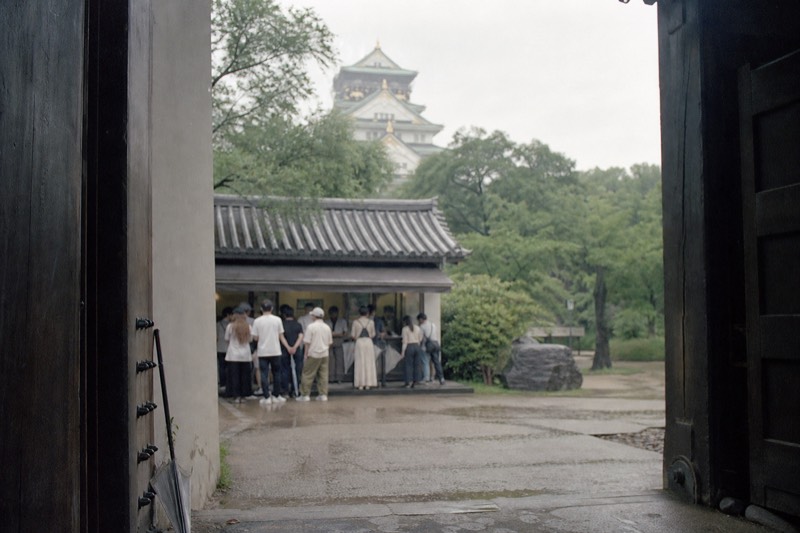
At The Gate
Adult, per person Group rate from 15 paying visitors Free categories at the window
¥1,200
The window price is identical to the online price, so nothing is lost by paying in person. Students and under-15s should buy here, because proof-of-age discounts are handled face to face and not through an e-ticket.
Students with ID and visitors aged under 15, since discounted and free rates are only applied at the window.
See what it covers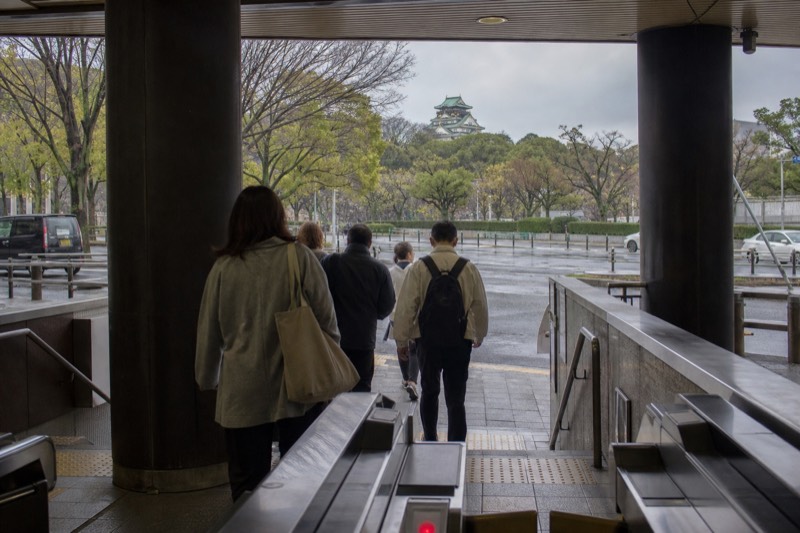
Osaka Amazing Pass
One-day pass On sale 25 March 2026 to 31 March 2027
¥3,500
The one-day pass costs 3,500 yen against the 1,200 yen castle ticket on its own, so it only pays off with two or more other paid sights. Add transport and the maths tips further in its favor.
Visitors packing several paid sights plus metro and bus rides into one day, who will clear the pass price easily.
See what it covers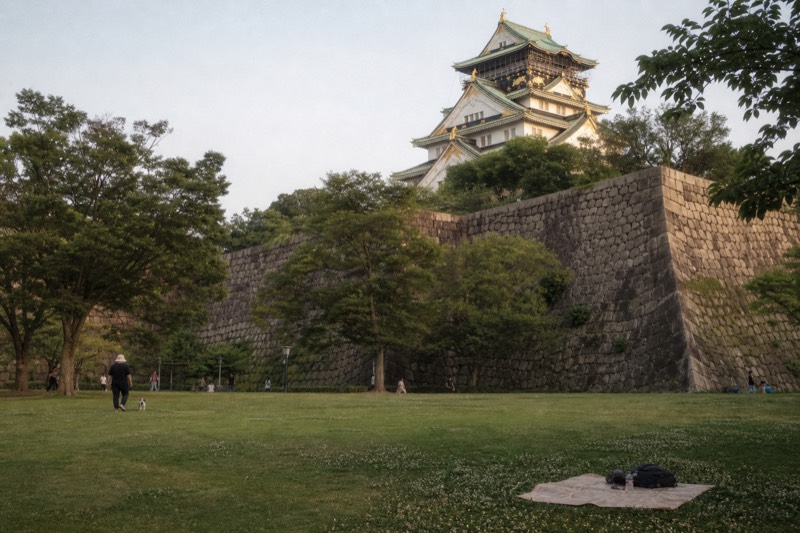
Free Park Areas
No admission charge
Free
The park grounds, moats, stone ramparts and exterior views of the tower cost nothing at all, and they fill a half day on their own. The paid line falls only at the Main Tower entrance and the Toyotomi Stone Wall Museum.
Anyone who wants the castle views, moats and grounds without paying to go inside the buildings.
See what it coversThe engineering detail is the one that rewards knowing. Because the 1931 tower was built to carry its weight on its own frame rather than on the tenshudai, when a bomb landed a few metres north of the tower on 14 August 1945, the day before the surrender, the blast slippage visible in the tenshudai stone wall from its north face round to its east face did not damage the tower. Corrective work on the mound followed in 1964. The 1997 Heisei Great Repair restored the tower to its 1931 appearance, and the park was itself created around it, opening as Osaka Castle Park on 7 November 1931, the same era as the rebuild.
So when you stand at the 8F observation deck, about 50 metres above ground per the official exhibition page, you are on a structure with three separate birth dates stacked below you: a 1583 Toyotomi foundation, a 1620s Tokugawa fortress, a 1931 citizen-funded museum. Visitors who only learn the third fact often leave disappointed that the interior is a museum. Visitors who learn all three tend to rate the view differently, because the layering is the point. If that framing suits you, the full history of Osaka Castle walks the timeline in order.
Is The View From The Top Worth The Climb?
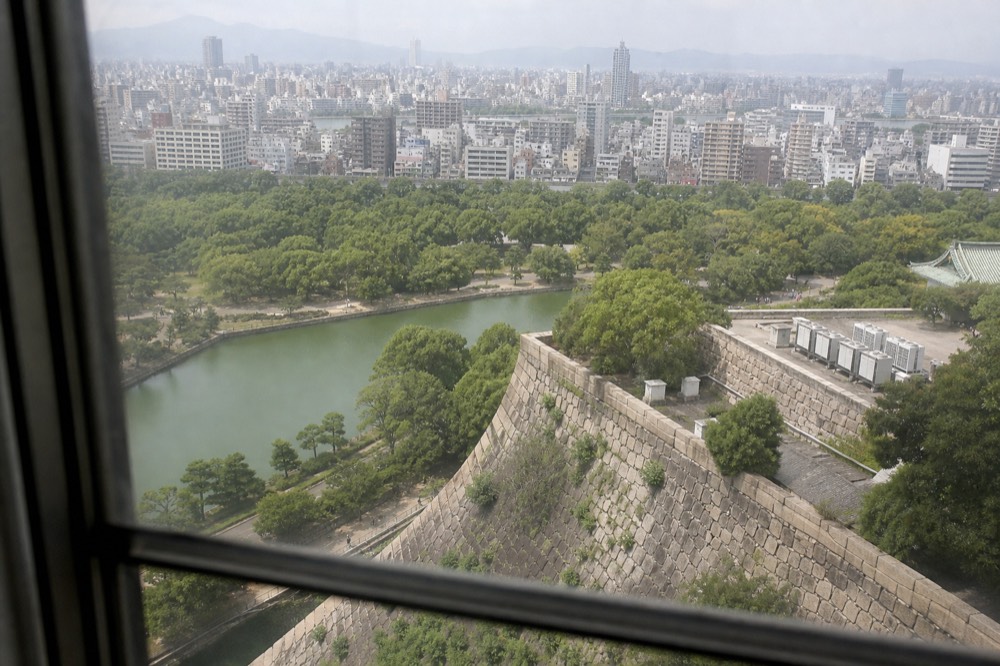
The 8F observation deck, about 50 metres above ground, is a public viewing deck roughly 50 m above ground inside the castle keep, and it looks out over the 105.6-hectare park, the moat systems radiating in every direction, and the Osaka skyline beyond. The castle's own FAQ says most visitors spend 50 to 60 minutes inside, 1.5 hours if you look properly, which frames how much there is to see.
The honest caveat first: the curatorial column's numbers show the view is slightly lower than the lost Tokugawa keep's would have been, by about 3 metres, and the deck is reached by stairs from the 5th floor, where the general-use up-only lift stops. Wheelchair users and visitors with walking difficulties may use the lift in both directions on every floor under staff guidance, and wheelchairs can go out onto the 8F deck itself, per the official exhibition page. The tower lends 5 wheelchairs, in-building use only, first come first served.
The deck reward is real. From roughly 50 metres you take in the whole scale of the fortress at once: the inner moat directly below, the 13 cultural-property structures dotted along the ramparts, Nishinomaru Garden's lawn and its roughly 300 cherry trees, and the modern city pressing in on every side. That contrast, an entire Tokugawa defensive system sitting inside a metropolis, is something no rural keep offers. Photography is free on the deck and banned on floors 3F and 4F, where the Important Cultural Properties are displayed. For planning, the practical details, including the ¥100-per-item bag check and the free audio guides in four languages, are in our inside Osaka Castle guide.
When Is Osaka Castle At Its Most Special?
The castle's most distinctive season is cherry blossom, but its official mechanism is unusual: the Somei-Yoshino specimen tree that declares Osaka's blossom opening stands inside Nishinomaru Garden, and on the day the announcement comes the tower is floodlit cherry-pink from sunset until 24:00, one night a year, announced only on the day. The 2026 Kan'o Nighter night opening ran 20 March to 12 April, 9:00 to 21:00, at ¥350.
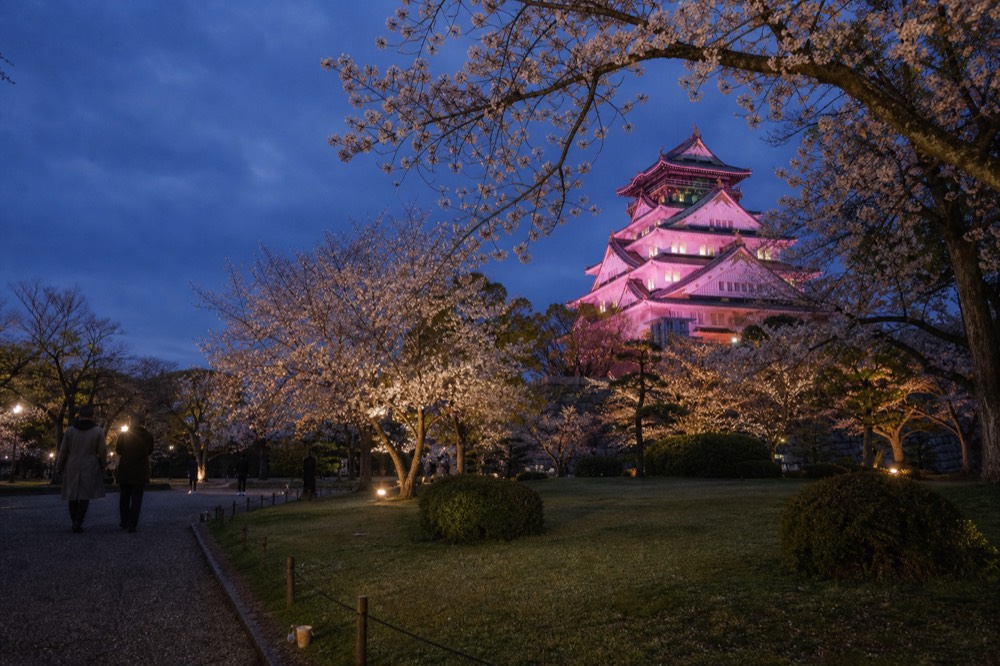
About 3,000 cherry trees, mainly Somei-Yoshino, make the park one of the Kansai region's premier blossom spots, and roughly 300 of them stand inside Nishinomaru Garden itself, where the shidarezakura weeping cherries add a second texture. The castle does something on announcement day that no other castle does: it turns the tower pink for a single night. There is no schedule for it in advance, because it is triggered by the meteorological declaration itself, five or six flowers open on the specimen tree.
The park's calendar gives the castle a year-round rhythm few rivals match. The Osaka Castle Spring Festival ran 10 March to 24 May in 2026. The Plum Grove, about 1.7 hectares on the east side of the inner moat with about 1,245 trees of 105 varieties, opens the season earlier and is tracked live by variety on the park's own table rather than promised for fixed dates. Free exterior floodlighting from sunset to 00:30 makes the castle a night attraction every evening of the year, not only in blossom season. For the seasonal specifics, see Osaka Castle at night and the cherry blossom guide.
The comparison with the alternatives is where the specialness sharpens. A Kyodo News report citing a Navitime analysis of navigation data ranked Osaka Castle the most popular castle among foreign visitors to Japan in 2025, a sign of how far its international profile has climbed. tells the same story from the official side. For how it stacks against the most common rival, see Osaka Castle vs Himeji Castle.
The short version of everything above: the buried Toyotomi stone wall visible since 1 April 2025, included in the ¥1,200 tower ticket, is the feature no other Japanese castle can match, and around it sit the greatest stone walls in Japan, a citizen-funded 1931 museum tower, and a provisional record 2,813,851 annual visitors. The details below unpack each part.
Common Questions About Osaka Castle
What's So Special About Osaka Castle?
The one thing no other Japanese castle offers: a section of Hideyoshi's original Toyotomi stone wall, buried under about 6 metres of Tokugawa fill and visible since the Stone Wall Museum opened on 1 April 2025, included in the ¥1,200 tower ticket. Around it sit the greatest stone walls in Japan, a 1931 citizen-funded museum tower, and a record 2.8 million annual visitors.
Is Osaka Castle A Real Castle Or A Reconstruction?
Both. The walls, moats and 13 surviving structures are the genuine Tokugawa-era fortress from the 1620s, mostly National Important Cultural Properties. The white tower is a 1931 ferro-concrete reconstruction funded by public subscription, after the original Tokugawa keep burned in 1665. It has been a museum since it opened.
What Is The Toyotomi Stone Wall Museum?
An underground gallery inside the honmaru, opened 1 April 2025, where you walk down to the buried wall that protected the tsumenomaru, the private quarters where Hideyoshi, Yodo-dono and Hideyori lived. There is no separate ticket: the ¥1,200 Main Tower admission includes it, same day.
How High Is The Observation Deck?
The 8F observation deck is about 50 metres above ground, per the castle's official exhibition page. No official page gives a single total height for the tower. The general-use lift runs up-only to 5F; from there, stairs to 8F. Wheelchair users may use the lift in both directions with staff guidance.
Is Osaka Castle Worth Visiting Compared To Himeji?
They answer different questions. Himeji is the intact original keep; Osaka is the layered one, with the buried Toyotomi walls, the greatest stone walls in Japan, the 8F deck at about 50 metres, and an urban park setting. In 2025 Osaka Castle ranked as the most popular castle among foreign visitors to Japan, per a Navitime analysis reported by Kyodo News in April 2026.
When Is The Castle Lit Up?
The free exterior illumination runs from sunset until 00:30 every evening, switching off on one annual inspection day. During the Kan'o Nighter blossom opening, Nishinomaru Garden extends its hours to 21:00, and on the day Osaka's cherry-blossom opening is declared, the tower is floodlit cherry-pink until midnight.
Whatever kind of visit you are planning, the two products that exist for this castle cover both halves of the specialness: the admission ticket for the tower and the buried wall, and a guided walk for the grounds that the ticket does not touch.